Legacy of Tourbillon
Author: Jane Nemecek, published: 25 Aug 2023, pictures: Sporthorse-Data
A recent TDN article reminded us how close we are to the extinction of Byerley Turk's line. Not that there is anything new about it: the 1980s books mentioned already how vulnerable the sireline is. However, it's not gone yet - so maybe it's the right time to both admire it and remind ourselves some of its traits. Which maybe, just maybe, may have led to today's condition.
History of the line
To tell the story of Northern Dancer, born in 1961, would be a terrifying task. To summarize Byerley Turk is much easier, suggesting how thin the line was during its entire existence. The first major branching occurred between 1768 and 1774, with three sons of Herod, and only a few others followed.
Florizel was responsible for the early American influences of Lexington and American Eclipse but by the end of the 19th century, this branch was generally gone - with the exception of Americus standing in Europe, and that's a whole different story. Florizel's grandson, Master Robert, played an utterly different role in the breed - he passed the grey gene from the oriental horses to the modern thoroughbred population.
Woodpecker was born seven years later and created the widest part of the line. He divided into Glencoe's influence in the U.S., Fisherman in Australia, Dollar's progeny in France, and at last, the mighty European grey lineage of Le Sancy - Le Samaritain - Roi Herode - The Tetrarch. Except for Tourbillon, Dollar contained a rare lineage of Badajoz and Epinard, who influenced a good number of modern European stallions.
Highflyer was represented by such ancient names as Wild Dayrell or Kisbér. This blood is hidden deep in modern pedigrees, but the original significance of Partisan's progeny was beyond measure with names like St. Frusquin, Ormonde, Le Roi Soleil, Fripon, or even Peter Pan in the U.S. Kisbér himself would add Charles O'Malley (and thus Blenheim), Bachelor's Double (Bellini, Precipitation, Persian Gulf, and Vilmorin), or Radium (Gallant Fox, Pharis, Brantome, and Donatello).
Scheme 1: Basic structure of Byerley Turk's sireline
- BYERLEY TURK, c. 1680
- Jigg (GB), c. 1700
- Croft's Partner (GB), 1718
- Tartar (GB), 1743
- Herod (GB), 1758
- Florizel (GB), 1768
- Diomed (GB), 1777
- Sir Archy (USA), 1805
- Timoleon (USA), 1814
- Boston (USA), 1833
- Lexington (USA), 1850
- War Dance (USA), 1859
- Lexington (USA), 1850
- Boston (USA), 1833
- Timoleon (USA), 1814
- Duroc (USA), 1806
- American Eclipse (USA), 1814
- Sir Archy (USA), 1805
- Diomed (GB), 1777
- Woodpecker (GB), 1773
- Buzzard (GB), 1787
- Castrel (GB), 1801
- Bustard (GB), 1813
- Heron (GB), 1833
- Fisherman (GB), 1853
- Heron (GB), 1833
- Pantaloon (GB), 1824
- Windhound (GB), 1847
- Thormanby (GB), 1857
- Atlantic (GB), 1871
- Le Sancy (FR), 1884
- Le Samaritain (FR), 1895
- Roi Herode (FR), 1904
- The Tetrarch (IRE), 1911
- Roi Herode (FR), 1904
- Le Samaritain (FR), 1895
- Le Sancy (FR), 1884
- Atlantic (GB), 1871
- Thormanby (GB), 1857
- Windhound (GB), 1847
- Bustard (GB), 1813
- Selim (GB), 1802
- Sultan (GB), 1816
- Glencoe (GB), 1831
- Vandal (USA), 1850
- Virgil (USA), 1864
- Hindoo (USA), 1878
- Hanover (USA), 1884
- Hamburg (USA), 1895
- Hanover (USA), 1884
- Hindoo (USA), 1878
- Virgil (USA), 1864
- Vandal (USA), 1850
- Bay Middleton (GB), 1833
- The Flying Dutchmann (GB), 1846
- Dollar (FR), 1860
- Androcles (FR), 1870
- Cambyse (FR), 1884
- Gardefeu (FR), 1895
- Chouberski (FR), 1902
- Bruleur (FR), 1910
- Ksar (FR), 1918
- Tourbillon (FR), 1928
- Djebel (FR), 1937
- Tourbillon (FR), 1928
- Ksar (FR), 1918
- Bruleur (FR), 1910
- Chouberski (FR), 1902
- Gardefeu (FR), 1895
- Cambyse (FR), 1884
- Androcles (FR), 1870
- Dollar (FR), 1860
- The Flying Dutchmann (GB), 1846
- Glencoe (GB), 1831
- Sultan (GB), 1816
- Castrel (GB), 1801
- Buzzard (GB), 1787
- Highflyer (GB), 1774
- Sir Peter Teazle (GB), 1784
- Walton (GB), 1799
- Partisan (GB), 1811
- Glaucus (GB), 1830
- The Nob (GB), 1838
- The Nabob (GB), 1849
- Vermouth (FR), 1861
- The Nabob (GB), 1849
- The Nob (GB), 1838
- Gladiator (GB), 1833
- Sweetmeat (GB), 1842
- Parmesan (GB), 1857
- Macaroni (GB), 1860
- Fitz Gladiator (FR), 1850
- Compiegne (FR), 1858
- Mortemer (FR), 1865
- Chamant (FR), 1874
- Mortemer (FR), 1865
- Vertugadin (FR), 1862
- Saxifrage (FR), 1872
- Compiegne (FR), 1858
- Sweetmeat (GB), 1842
- Glaucus (GB), 1830
- Partisan (GB), 1811
- Sir Paul (GB), 1803
- Paulowitz (GB), 1813
- Cain (GB), 1822
- Ion (GB), 1835
- Wild Dayrell (GB), 1852
- Buccaneer (GB), 1857
- Kisbér (HUN), 1873
- Buccaneer (GB), 1857
- Wild Dayrell (GB), 1852
- Ion (GB), 1835
- Cain (GB), 1822
- Paulowitz (GB), 1813
- Walton (GB), 1799
- Sir Peter Teazle (GB), 1784
- Florizel (GB), 1768
- Herod (GB), 1758
- Tartar (GB), 1743
- Croft's Partner (GB), 1718
- Jigg (GB), c. 1700
Omiting the influence on the breed and considering just particular bloodlines, it's not much - especially compared to Darley Arabian, who branched into madness and created tens of distinguishable lineages. Byerley Turk was lucky to survive into modern times with just two lineages: The Tetrarch and Tourbillon.
Tourbillon
When you look at the scheme above, there's one curiosity hidden in the sireline. Dollar's son Androcles placed in the Prix Gladiateur over 4 miles, Cambyse placed over two miles, and so did Gardefeu in the Ascot Gold Cup. Chouberski and Bruleur both won over 1 7/8 miles. Considering these dispositions, it's fascinating that eight generations from Dollar to Tourbillon spanned only 68 years. The sireline was surprisingly "fast" for stayers who needed some time to develop, and generally are not very prolific sires; and it would be even faster without the 14-years gap between Androcles and Cambyse.
Current debaters may also enjoy the fact that Chouberski ran just once, some say due to injury, and his grandson Ksar is the most famous example of close inbreeding, with a rare 2x3 to Omnium II. Nevertheless, Bruleur, Ksar, and Tourbillon collected 7 titles of the leading French sire among themselves; Djebel and Goya, both by Tourbillon, would add three more.
Ksar is firmly imprinted in fans' minds as one of the greats and certainly was on a racetrack. But except for Tourbillon, his legacy at stud remained somewhat limited. Ukrania won the Prix de Diane and Thor the Prix du Jockey Club; Le Ksar robbed Tourbillon's Goya II of the Two Thousand Guineas. Le Pacha, Kingsway, and many others added classic accolades in further generations but the only other descendant with international influence was, probably, Ksar's great-grandson Wild Risk.
Tourbillon was a blue-blooded prince, as his first six ancestors were classic or top winners. And while not unbeatable, he made up for it at stud. In fact, he and Djebel managed to create hints of branches among their progeny in a modern sense - similar to Northern Dancer or Mr. Prospector's sons later and unseen anywhere within the whole Byerley Turk's line. However, they remained the only two stallions of the entire line who managed to do so, which definitely compromised the chances for the line's survival. Two key stallions are just too little for any sireline, any era.
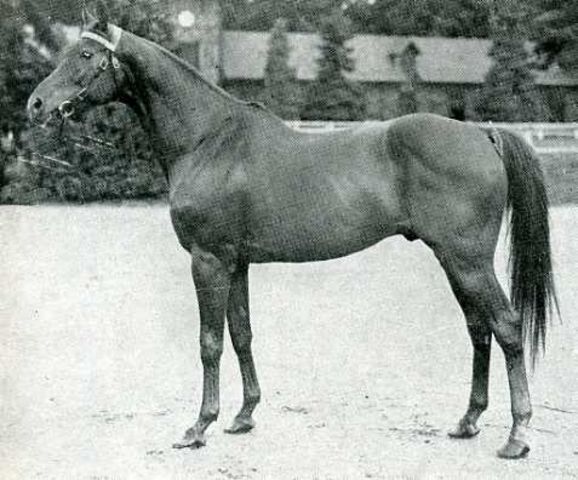
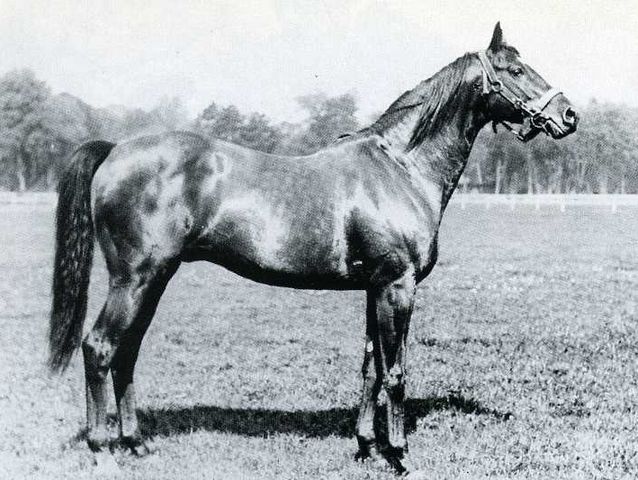
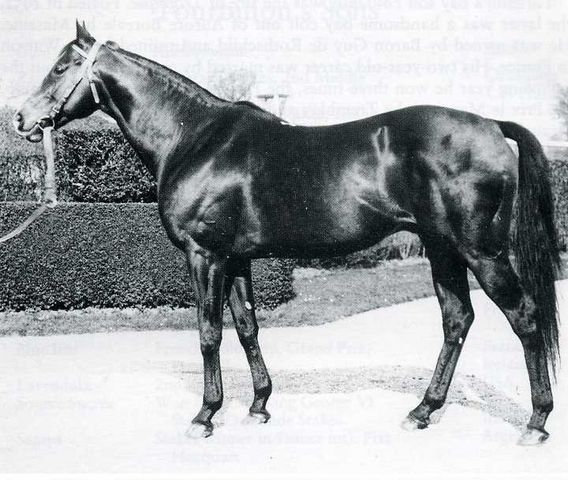
Tourbillon, born in 1928, was a contemporary of Tetratema's sons. And as astonishing as the legacy of The Tetrarch was, by the 1930s, the grey lineage was obviously in trouble. Basically all its big winners or classic horses couldn't succeed as sires: Stefan the Great was sent to the US after several years at stud; Royal Minstrel and Gino right off the track. So was Polemarch, who became a classic sire in Argentina. Caligula, Mr. Jinks, and Salmon-Trout, who remained home, had very little success. Theft made history in Japan as a leading sire and a sire of classic winners, but without a male successor.
This whole list doesn't deny anything from The Tetrarch's talent and significance - suffice to say that he was a forgotten damsire of Pilate, as well as the third sire of Nasrullah, Mahmoud, and Abernant. Tetratema would become a damsire of Big Game and Palestine, Ethnarch would add Khaled, and Stefan the Great wound up being the third sire of Count Fleet. Even this short listing covers most modern bloodlines, even descendants of Relaunch or Sunday Silence. But ever since The Tetrarch himself, males were missing.
The longest-living lineage of The Tetrarch was none of the previously mentioned. In 1929, baron de Rotschild bred a strangely-named Bactériophage, an in-utero imported son of Tetratema, who subsequenty started the whole derived French lineage: Bactériophage (damsire of Prince Bio) - Teleférique (damsire of Le Haar) - Alizier (Prix de l'Arc de Triomphe second in 1950) - Sigebert (Prix de l'Arc de Triomphe second in 1966). Sigebert, a son of Sicambre's full sister, wound up standing in Germany and even brought this lineage to the early 1980s. It still remained only marginal, and by the time Tourbillon's son Djebel arrived on the scene, the fate of The Tetrarchs was mostly sealed.
Tourbillon and Djebel did great, that's a well-documented record in history books. But their progeny kept some traits observable along the Byerley Turk clan, which, when it comes to the survival of the sireline, turn into really unwanted and troubling characteristics, not unlike those of The Tetrarchs. First of all, there was no major sire of sires, and I recommend checking the Scheme 2 below this section for a better orientation. Even Goya II, a proven classic sire, was nothing like that.
Furthermore - even with success on the racetrack, a lot of top-class colts didn't develop as sires. This applies especially to the numerous Derby and Arc winners - Cillas, Caracalla, Galcador, Good Luck, Rapace, Puissant Chef, or Nelcius. Other stallions mimicked them later in a conspicuous way - Jimmy Reppin, My Swallow, or Sagace and his son Arcangues. And doesn't this sound suspiciously similar to what happened to modern winners like Domedriver, Indian Haven, or Notnowcato?
While many of these colts were undoubtedly horses of the great class, they were virtually useless at stud - or at least, highly ineffective. Even Saint Cyrien, who happened to be the leading French sire in 1990, didn't sire and influence literally anything else except that crop's double Gr.1 winner Epervier Bleu.
Speaking of Indian Ridge, he stood out in two aspects. The first is public knowledge: Tourbillons were no sprinters, and in fact, even Djebels could run far beyond a mile and a half. Klairon's progeny didn't necessarily follow these rules. And secondly, unlike many others, Indian Ridge WAS a successful and respected sire. This second point probably led most of us to conviction that the sireline should have continued with his progeny. Now that we know this won't probably happen, there's another lingering feeling: that we, as breeders, failed when we couldn't ensure it.
Could have Djebel's extinction been prevented?
Questions like these are tough ones, if you want to answer them honestly. This article - more a loose collection of events rather than a story, I'm sure you noticed - aspired to do two things. Aside from celebrating Tourbillon and Djebel, their talent and enormous influence of the whole "BT" clan, I also wanted to point out troubles of the sireline during its existence. Troubles that were, it almost seems, its general traits. And while the brutal ineffectivity of producing male successors was well presented, it's still not sufficient to make conlusions about the sireline's survival. Especially because of Indian Ridge.
When preparing the article about trends in European pedigrees, I took time to make at least a rough comparison of crops between the most prolific Northern Dancers of the past decades (Galileos, Danehills, Green Deserts, etc.) and marginal bloodlines - Nasrullahs, Djebels, or last Fairways. I didn't use it after all, but I saved the data. Generally, they prove one trend in current breeding that may be felt sometimes, especially when you're following minor bloodlines: while "hot" stallions are heavily favored, with 100-120 foals per season, at the same time, some non-fashionable bloodlines are handicapped by the lack of interest. In better case, it means only significantly smaller crops for its stallions, often less than 50 foals per season; in worse ones, quick sales to some exotic destination or a long-term lease to Southern hemisphere. Both ways, we greatly reduce chances of both stallions and their bloodlines to thrive.
Getting to the exact figures, Ela-Mana-Mou, Fairway's last top descendant, had an average of 20 foals per crop. Mtoto, one of the last British Blandfords, had less than 30. Mtoto's son Shaamit, who won the Derby, had about 20 foals in each of his initial three crops - and it's an incredible number for the Derby winner at the end of the 20th century. I'm not sure about potential fertility or health issues, merely stating the numbers - which, nonetheless, clearly contributed to the subsequent extinction of these lineages.
Surprisingly enough, this was not the case for Djebels. Indian Ridge and Compton Place had an average of 50 foals per season; Inchinor had more than 40. Even Dr. Devious, when he returned to Ireland after his initial four seasons in Japan, had sound 50 foals per crop. Domedriver and Indian Haven were a different story, but the point still is: in the 1990s, Djebel line stallions DID have a fair chance. Not the best one, compared to the fashionable Northern Dancers - but still probably a viable one.
It's quite an irony that the business gets publicly accused of causing Djebel's extinction because next to all really omitted bloodlines, Djebel, most of all, doesn't feel like the case. Much in the same way as The Tetrarch was not the case - I've never heard people doubting The Tetrarch's extinction as someone's fault, only his descendants were mostly clear failures at stud. But not only Djebels enjoyed some great success - Luthier was a four-time champion sire in France, and Indian Ridge even made it to the internationally renowned circles, which was a monster achievement; the top Djebels remained in Europe and were given some chance.
At this point, let's stop to consider: What were breeders supposed to do? Or to do differently? Not just with stallions like Luthier's sons, who had an average of two Group performers per lifetime, but also with Indian Ridge himself, the supposed savior of the sireline. Indian Ridge had 50 live foals per crop, and almost 900 foals per lifetime. And still, he managed to sire only one good stallion in Compton Place - still a stallion with five Gr.1 foals, to be clear.
We must ask - what makes us think that with twice as many foals, the outcome would be significantly different? Are we really thinking that from 1800 foals, suddenly, there would be some stallion superstars among Indian Ridge's progeny, or prepotent sires of sires of a caliber of Danzig and Sadler's Wells?
In my opinion, far more likely, Indian Ridge would add one or two good stallions to Compton Place, and a couple fo bad ones. And that'd be it.
For the record, Hyperion had 500 foals, and Blandford about 200 - yet both managed to create dynasties. And that seems to be the exact difference between, if you will, branching sirelines and dying ones. From brutal stallion male power, like we've seen in Nasrullah or Northern Dancer; to a sufficient talent like Djebel; to a simple lack of such abilities. The last thing can't work well, at least in a modern breeding business, which is about commerce instead of small local miracles.
There's a funny postscript: According to the recent research, St. Simon should be genetically linked with Byerley Turk instead of Darley Arabian. But with his enormous stallion power and sire of sires' talent - to say that he "doesn't fit" the picture of the whole Byerley Turk's line is a gross understatement.
Last hopes
Most fans are well aware that the sireline's not gone yet. First, let's make a short overview of recent events:
Indian Ridge died in October 2006 due to an apparent heart attack. Definite Article followed his sire exactly 8 years later. Compton Place could not be saved after a bout of colic in September 2015. Dr. Devious died in Italy in 2018. Dunaden died in a paddock accident in May 2019, and Notnowcato only a few months later. For some time after, we could comfort ourselves by having Indian Haven, even though he was an indifferent sire. He died peacefully in his paddock in July 2023.
Domedriver was listed as a stallion in France in 2014 but his death was not reported yet. And I'm also having trouble tracing Imperial Stride, a South African sire by Indian Ridge.
The remaining Djebel sires, globally, should be:
- Captain Chop, 2008, by Indian Rocket. 2. Prix de Cabourg Gr.3 (6f, 2yo). Should still reside at Haras des Faunes in 2025;
- Pearl Secret, 2009, by Compton Place. 1. Temple Stakes Gr.2 (5f). Resided at Norton Grove Stud; was sold to Arrow Stud, Japan for the 2025 breeding season.
- Lucky Team, 2012, by Namid. 3. Prix Lyphard LR. Resides at Haras de la Haie Neuve, France. Pedigree, France-sire profile.
- Possibly also:
- Libano, 2006, by Indian Ridge. 1. Premio Parioli Gr.3 (ITY). Resided at Allevamento Poggio dei Sabini, Italy. Pedigree.
- Comical, 2011, by Linngari. 2. Clasico General Pueyrredon Gr.2 (ARG). Young sire in Uruguay. Pedigree.
- Shifting Power, 2011, by Compton Place. 2. Irish 2000 Guineas Gr.1. Sent to Badal Stud, Punjab, India.
If you know another provably active stallion (at least in 2023 & not deceased), please let me know on social media or by e-mail. I'll gladly update the list for all of us.
We got to the last point that needed to be said. But you noticed that this article is dedicated to Tourbillon, and I owe you an explanation - why? Marginal regions often harbor relics of archaic bloodlines, and well, mine had the honor of having Tourbillons. Until very recently.
The last Tourbillons
First, let me say that France had Tourbillons for a very long time. It was thanks to the unmentioned lineage of Medium - Misti IV - Mistigri. Misti was a damsire of Ile de Bourbon but the lineage got more famous as a national hunt blood, including Misti's son Roselier, a sire of two Grand National winners in Royal Athlete and Bindaree. Mistigri's son Discover d'Auteuil, another Gr.1 national hunt sire, died in 2012, but he was not the last one.
You're never quite sure about "the last" with bloodlines, but another branch, a Central European one, existed in Poland and Czechia. It was thanks to the Polish breeders, who bought a stallion named Conor Pass in 1976. He won a pair of Gr.2 races and, most notably, the Irish St. Leger over Star Appeal. Conor Pass sired two Polish Oaks winners, the St. Leger winner, and a colt named Dixieland, who won the Nagroda Wielka Warszawska, a top comparative race. Dixieland's foals won numerous classic races, but the final chapter was written by unexpected horses: chasers, most notably a colt named Scater.
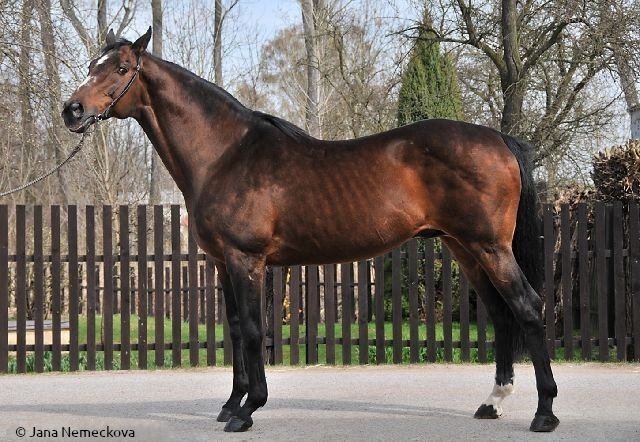
Scater (pedigree) was born in 1990, and I was honored to take pictures of him for the Equichannel in 2012. You can appreciate his condition at the age of 22, just like we did, and he bred mares up to the age of 27. He died in January 2018.
Scater was a major flat winner and a monster chaser. Bred mostly to his owners' mares, Scater sired only about 80 foals in 19 crops, but they included 15 top horses. The author particularly loved his flat performers, but the best overall was Nikas - the top chaser who sadly failed a drug test after his victory in the Great Pardubice steeplechase (contaminated feed). Scater's daughters produced some great horses, too.
While these are nothing more than some minor, local horses in the thoroughbred world population, Scaters - Czech Tourbillons - were greatly appreciated by fans. They had natural talent, they were fighters and also lookers. Most of all, they achieved sensational success, given the circumstances - starting with the fact that few breeders would stand stallion like Scater in the 21st century.
Since Scater died quite recently, we still meet his progeny - whether in local OTTB Facebook groups or similar groups for mare owners. It's amazing to have these horses around, although, to be honest, I didn't even realize how special this situation was until the last Djebels began to disappear.
That's why I decided to honor Tourbillon today. Even these days, somewhere, he's still appreciated, and his progeny will be dearly remembered.
Scheme of Tourbillon's sireline
- Tourbillon (FR), 19281. Prix du Jockey Club, 2. Prix Royal-Oak
- Goya II (FR), 19342. Two Thousand Guineas, Champion Stakes
- Goyama (FR), 19431. Coronation Cup, 2. PRix de l'Arc de Triomphe
- Tenareze (FR), 19533. Poule d'Essai des Poulains
- Nelcius (FR), 19631. Prix du Jockey Club
- Tenareze (FR), 19533. Poule d'Essai des Poulains
- Sandjar (FR), 19441. Prix du Jockey Club
- Jardiniere (IRE), 1952
- Jalon (CHI), 1961
- Jardiniere (IRE), 1952
- Good Luck (FR), 19461. Prix du Jockey Club
- Goyama (FR), 19431. Coronation Cup, 2. PRix de l'Arc de Triomphe
- Cillas (FR), 19351. Prix du Jockey Club
- Meridien (FR), 1936
- Medium (FR), 1946
- Misti IV (FR), 1958
- Mistigri (FR), 1971
- Misti IV (FR), 1958
- Medium (FR), 1946
- Djebel (FR), 19371. Poule d'Essai des Poulains, Two Thousand Guineas, Prix de l'Arc de Triomphe
- Arbar (FR), 1944
- Abdos (FR), 1959
- Clarion (FR), 1944
- Klairon (FR), 19521. Poule d'Essai des Poulains, 3. Two Thousand Guineas
- Lorenzaccio (IRE), 19651. Champion Stakes
- Ahonoora (GB), 19752. King's Stand Stakes
- Don't Forget Me (IRE), 19841. Two Thousand Guineas, Irish 2,000 Guineas
- Indian Ridge (GB), 19851. King's Stand Stakes
- Definite Article (GB), 19922. Irish Derby
- Vinnie Roe (IRE), 19981. Prix Royal-Oak
- Compton Place (GB), 19941. July Cup
- Indian Rocket (GB), 19943. July Cup
- Namid (GB), 1996Prix de l'Abbaye de Longchamp
- Nicobar (GB), 1997
- Dunaden (FR), 20061. Melbourne Cup, Caulfield Cup, 2. Coronation Cup, 3. Prix Ganay, HK Vase, etc.
- Domedriver (IRE), 19981. Breeders' Cup Mile, 2. Prix Jacques le Marois
- Indian Haven (GB), 20001. Irish 2,000 Guineas
- Linngari (IRE), 2002
- Definite Article (GB), 19922. Irish Derby
- Dr. Devious (IRE), 19891. Derby Stakes, 2. Irish Derby
- Inchinor (GB), 19902. Dewhurst Stakes
- Notnowcato (GB), 20021. Juddmonte International, Eclipse Stakes
- Ahonoora (GB), 19752. King's Stand Stakes
- Luthier (FR), 19651. Prix Jacques le Marois
- Twig Moss (FR), 19732. Prix du Jockey Club
- Sagace (FR), 19801. Prix de l'Arc de Triomphe
- Arcangues (USA), 19881. BC Classic
- Saint Cyrien (FR), 1980French champion 2yo
- Lorenzaccio (IRE), 19651. Champion Stakes
- Klairon (FR), 19521. Poule d'Essai des Poulains, 3. Two Thousand Guineas
- Le Lavandou (FR), 1944
- Le Levanstell (IRE), 19571. Sussex Stakes, Queen Elizabeth II. Stakes
- Levmoss (IRE), 19651. Prix de l'Arc de Triomphe, Ascot Gold Cup
- M-Lolshan (IRE), 19751. Grosser Preis von Baden, 2. St. Leger
- My Swallow (GB), 1968French champion 2yo colt, 3. Two Thousand Guineas
- Le Moss (IRE), 1975Stayers' Triple Crown - 2x
- Levmoss (IRE), 19651. Prix de l'Arc de Triomphe, Ascot Gold Cup
- Le Levanstell (IRE), 19571. Sussex Stakes, Queen Elizabeth II. Stakes
- Djeddah (FR), 1945Eclipse Stakes, Champion Stakes
- Midsummer Night (USA), 1957
- Jimmy Reppin (GB), 19651. Sussex Stakes, Queen Elizabeth II. Stakes
- Midsummer Night (USA), 1957
- Djefou (FR), 1945
- Rapace (FR), 19521. Prix du Jockey Club
- Puissant Chef (FR), 19571. Prix Royal-Oak, Prix de l'Arc de Triomphe
- My Babu (FR), 19451. Two Thousand Guineas
- Better Boy (IRE), 1951
- Century (AUS), 1969
- Centaine (AUS), 1980
- Rubiton (AUS), 1983
- Century (AUS), 1969
- Our Babu (IRE), 19521. Two Thousand Guineas
- Milesian (IRE), 19531. Imperial Produce Stakes
- Partholon (IRE), 19601. National Produce Stakes
- Mejiro Asama (JPN), 1966
- Mejiro Titan (JPN), 1978
- Mejiro McQueen (JPN), 1987
- Mejiro Titan (JPN), 1978
- Symboli Rudolf (JPN), 1981
- Tokai Teio (JPN), 1988
- Mejiro Asama (JPN), 1966
- Partholon (IRE), 19601. National Produce Stakes
- Crozier (USA), 19582. Kentucky Derby
- Crested Wave (USA), 19761. Futurity Stakes (USA)
- Precisionist (USA), 19811. Breeders' Cup Sprint
- Better Boy (IRE), 1951
- Galcador (FR), 19471. Derby Stakes, 2. Poule d'Essai des Poulains
- Hugh Lupus (FR), 19521. Irish 2000 Guineas, 2. Irish Derby
- Hethersett (GB), 19591. St. Leger
- Blakeney (GB), 19661. Derby Stakes
- Julio Mariner (GB), 19751. St. Leger
- Tyrnavos (GB), 19771. Irish Derby
- Rarity (IRE), 19672. Champion Stakes
- Blakeney (GB), 19661. Derby Stakes
- Hethersett (GB), 19591. St. Leger
- Arbar (FR), 1944
- Tornado (FR), 19392. Prix du Jockey Club, Prix de l'Arc de Triomphe
- Fontenay (FR), 19461. Prix Ganay
- Tropique (FR), 19521. Eclipse Stakes, Coronation Cup
- Paveh (GB), 19631. Irish 2000 Guineas, 3. Irish Derby
- Tropique (FR), 19521. Eclipse Stakes, Coronation Cup
- Tyrone (FR), 19541. Poule d'Essai des Poulains
- Thymus (GB), 19561. Poule d'Essai des Poulains
- Tiepoletto (FR), 19561. Grand Criterium
- Tiepolo (GB), 1964
- Conor Pass (IRE), 19701. Irish St. Leger
- Tiepolo (GB), 1964
- Fontenay (FR), 19461. Prix Ganay
- Caracalla (FR), 19421. Prix Royal-Oak, Prix de l'Arc de Triomphe
- Coaraze (FR), 19421. Prix du Jockey Club, 2. Poule d'Essai des Poulains
- Emerson (BRZ), 19581. Gran Premio Cruzeiro do Sul
- Solicitor (FR), 19742. Prix Jean Prat
- Emerson (BRZ), 19581. Gran Premio Cruzeiro do Sul
- Timor (FR), 1944
- Pronto (ARG), 1958
- Practicante (ARG), 19661. Gran Premio Carlos Pellegrini, San Juan Capistrano Handicap
- Pronto (ARG), 1958
- Tourment (FR), 19441. Prix Royal-Oak, 2. Prix du Jockey Club
- Ambiorix (FR), 19461. Grand Criterium, 2. Prix du Jockey Club
- Count Amber (USA), 19572. Travers Stakes
- Amberoid (USA), 19631. Belmont Stakes, 3. Preakness Stakes
- Ambiopoise (USA), 19583. Travers Stakes
- Faraway Son (USA), 19671. Prix de la Foret
- Count Amber (USA), 19572. Travers Stakes
- Cagire (FR), 1947
- El Toro (IRE), 19561. Irish 2000 Guineas
- Goya II (FR), 19342. Two Thousand Guineas, Champion Stakes