Hello, my name is Jane Nemecek, and I'm 39. My life always revolved around horse-racing, and as years went by, I got quite into trouble when introducing myself: I was a racing & breeding news writer, professional racetrack & stud photographer, editor, publisher, web creator; researcher, historian; book author; and after all, bloodlines analyst and statistician. Needless to say, I never stopped doing most of these things. :)
Since my portfolio gets insanely broad - more of that in the "About me" section - I decided to make a "career & work summary" with some links. E-mail & social media links are attached at the end of the article.
TB Diamond (2002 - 2019) -> The Breeders' Handbook (2019 - now) - www.chovatelsky-zapisnik.cz
Up to these days, I don't know where I picked up one unfortunate attitude: when I consider something necessary, I just go and do it. So somewhen around 2002, still merely a high school teenager, deeply missing any local internet resources and having a similarly focused friend - I jumped right into creating one.
That's how became a founder, creator, owner, and co-author of one of the very first horse-racing websites in the Central European region. It originally covered the international racing news, including extensive Royal Ascot and Breeders' Cup reports; for those, I even contracted some American photographers way before social media times. The web also published many stories about local racing history, and for some time, even overviews of breeding theories. "Franco Varola: Timeless concept lost in time" remains one of my favorite works of all times.
In the late 2010s, we developed an entirely new type of content. The website was transformed into a huge resource on local thoroughbred stallions and mare families, with comprehensive profiles and breeding analyses. The name of the website has been changed, and we managed to build an amazingly kind and supportive Facebook community.
- Examples of our articles:
- Rainbows For Life - a comprehensive (well, more honorary) article on the Canadian champion racehorse and the best Czech stallion of all times
- Céda - an example of a mare family profile, describing a legendary local pre-war family of Céda
- Fortina - a "historical research article" on a great British chaser and influential national hunt stallion with Czech roots
I still can't fully believe that we managed to keep this project alive for so long - and despite there's no fame or money involved, or any other "socially recognizable" achievement - for me, it's a very special type of accomplishment. A very fulfilling one.
My original news-writing job on the website helped me to get another amazing early experience:
European Bloodstock News (2002 - 2009) - still a high-school kid, I became a Czech contributor to the British daily which covers racing, breeding, and sales news from all over the world. My work for them lasted until the Czech section was completely cancelled.
Professional photographer (2004 - 2009) - Accredited racetrack & bloodstock photographer, cooperating with the leading Czech studs & trainers.
Do I even need to say that this hobby of mine lasts up to these days? Or that this was one of the best jobs I ever had. Running the soft turf in front of the cheering grandstands... As well as sauntering in the morning fog, trousers wet up to me knees, quietly admiring the best broodmares in the country while the first beams of the rising sun were searching their ways through the trees...
I was lucky to photograph 14 Derby winners, three Triple crown winners, eleven champion sires - and countless magical moments on both the turf and pastures.


Bloodlines' analyst (2015 - now)
Is this the right place to mention how I became one? Not quite sure about it - but it WAS a career-forming experience. Somewhen around 2015, I began to notice that Sadler's Wells' stallions seemingly... began to lose their position. You will probably agree that teenage and early adult years are the most intense ones, and for me, those were all about being STUNNED by Sadler's Wellses. By all criteria and judged even decades later, Sadler's Wells' reign was something nobody had ever seen before, and the best was just happening: Montjeu, High Chaparral, Galileo. Uncountable progeny of their older brothers everywhere around. But a mere 15 years later, except for Galileo, they seemed to be disappearing. Since nobody was talking about the subject, I decided to find out what's going on.
That's how I began to try my first analyses. To be honest, there's not much science in counting Sadler's Wells' sons in pedigrees :) But I've also been a lifetime bloodlines enthusiast, and I've especially loved American racing history. I was also curious about Japanese bloodlines... and Australian bloodlines... and before I knew it, literally, I made my first steps on the path of a statistician and analyst.
Once it started being serious, it also stopped being easy. First, it required the whole classification of sirelines themselves - and going back to St. Simon's times, this is NOT as easy as it sounds! Then setting up many procedures to process the ever-growing amount of data, and most of all - years of adjustments followed as I was adding data from new regions. For example, historical Japanese and South American data had to be incorporated into the entire modern global analysis full of Danehills and Mr. Prospectors.
In 2021, I finally realized how incredibly powerful tool I have in my hands. Finally tuned for a comfortable work & 100% accurate results with numerous cross-checks, I could rely on it enough to reproduce its results publicly. What they now provide (or can do) are both local and global statistics on stallions, sirelines, entire pedigrees, inbreeding, and even strategies employed by breeders. And any related statistical stuff that's possible to extract but nobody will probably ever use. :)
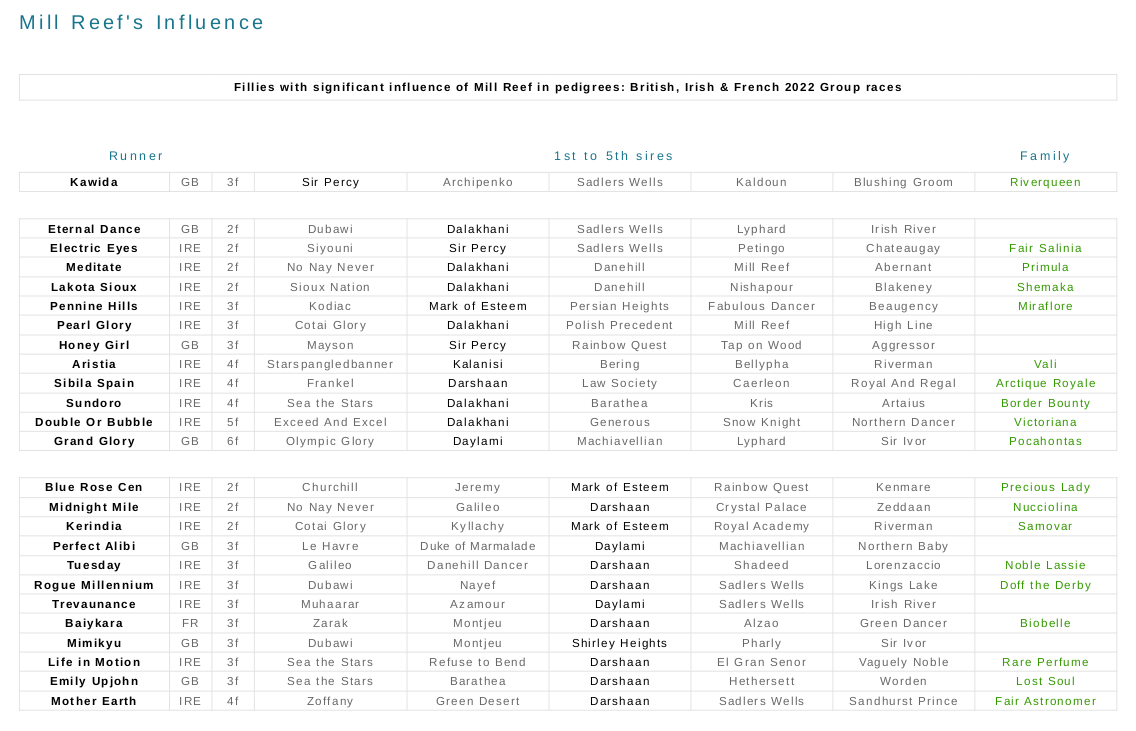
In one aspect, my work on global analyses became a dream fulfilled. While analyzing the backgrounds of pedigrees and all the historical bloodlines, I managed to get a fascinating map of the development of bloodlines over the past 150 years. In the entire thoroughbred population, throughout times, throughout all parts of the world. It's a fascinating material, and I'm still deeply sorry that I'm not able to reproduce it, somehow, to the wide racing public. I'd love to, but it's not a kind of project I can do on my own anymore.
Historian focused on thoroughbred families (2016 - now)
My primary interest always lied in stallions and sirelines. But the TB Diamond website got to harbor an opus magnum of my lifelong friend: a series of articles on historical families in the region. I don't remember exactly what happened next: inspired by her, I wrote a few articles on some modern broodmares, enhanced with new family schemes and picture galleries; I also started to upgrade some of her old profiles. Both were incredibly well received by local fans. However, this was not a start of a systematic work yet; just a raise of genuine interest which broadened over time, for example to German families.
The real work came with advanced sirelines analyses, when I began to notice local families repeatedly in pedigrees, and became curious about them - this time, especially about American and historical French ones. To start mapping them was an easy step from there.
What does this work even mean to me? Well, we all know that the great matriarchs are essential in the history of the breed. But the thoroughbred is not just about matriarchs - in fact, there seem to be tens or probably hundreds of smaller family units, which contribute to the entire thoroughbred population, including Gr.1 winners. And that's what I've always been like: fascinated by small stories and how things work, rather than by big names.
- Schwarzgold - a world-famous German family of Sagace, Steinlen, Slip Anchor, or Stacelita
These thoughts and interests also led me to the biggest mistake of my life: publishing a book, a monograph about the legendary local thoroughbred family La Lézarde (ISBN 978-80-7392-357-0; 2021, 160 pages). Although repeatedly described as "a jewel" and "a must-have," it was way too detailed and data-oriented for common readers, resulting in a sale of very few copies.
It was a priceless lesson, though. This gigantic mistake, financed exclusively by yours truly, forced me to reconsider the whole work we've been doing online. To really think through how readers perceive our work, what types of information are sensible, and which form is both attractive and understandable enough. Subsequently, we managed to come up with the new publishing form you now get to see in articles like Schwarzgold: reader-friendly, clearly arranged, easy to understand, visually attractive.
Our readers responded with great interest in such articles, even beating magazines and news. I'm still grateful for this shift. It's not the popularity that matters to me - it's confidence in our work, and knowledge that we can connect our modern readers with our own racing and breeding history.
And just for fun...
You possibly noticed one of my primary traits: I'm interested in many things about thoroughbreds, and generally, I want to know how they work and why. It's apparent on this website, too, like with the article on the mechanisms creating inbreeding, or the thoughts about Djebel's extinction. I never quite understood why am I this way, until very recently - as you can read in my bio.
It sure is an advantage for a data analyst - but not so much for a common person, who can come up with some foolish ideas. :)Like the day I decided to trace the grey gene in the thoroughbred population.
And I can state confidently that I did so - as summarized in a 50-page series of articles from 2017. Sadly, it's just in Czech; I really dream about translating it into English some day.
Worse things were to come, though, because I became similarly occupied with the whole possibility of the existence of Cream dilutes in the breed, and subsequently, with Dominant white horses. I still recall the absolute amazement when I first saw Puchilingui on some old Barbara Livingston photo - and that was many, many years before anybody heard about Sodashi.
So with constant Q&As in my social circles, and pretty well-trained from the Grey gene research, I used both my knowledge and publishing skills to explain the genetics and lineages of "colored" thoroughbreds:
- Cream thoroughbreds - historical palominos and modern lineages of Milkie and Glitter Please
- Overos - historical "spotted" thoroughbreds, Ky Colonel, Candy Spots, and lineages of Ghazi, Dancebel, and Racey Remarque
- Dominant white mutation - list of historical incidences, theories on its origin, genetics, and lineages from all over the world, incl. White Beauty, Puchilingui, Airdrie Apache, and Shirayuikihime. Additional thoughts on used and official terminology, concerning particular breeds and their associations.
What else is going to come? I'm not sure. I can safely say that until now, I've written thousands of pages of materials, and most of them are not even published - they are either unused articles or my "work files", all of them carefully archived. They include extensive materials on the history of sirelines, and I can only repeat myself - hopefully, I'll find some ways to publish them some day.
Current work?
I spent the year 2024 mostly trying to offer a hand to local authorities and breeders, to help promote local racing. Not much luck with that. So as of early 2025, I'm catching up on some unfinished business, the 2024 analyses in the first place.
But there's an article I started in the late 2024 that I could mention. Well, it already has 23 pages and really got me thinking about my future as a writer :) It was supposed to be about Animal Kingdom's family and its German and Hungarian origins, as I happen to have both an extensive archive on the subject and knowledge of local environment and history. And like many others, it's an utterly fascinating story...
Truth be told, I ended up tangled in the German racing history. It's a subject for another book itself - and another one I'd love to do one day. But another truth is, the financial aspect of my work just raised its voice a bit on me. But I'm sure not giving up - you'll get to see this text in full, I promise.
"The decades after Oleander's Arc de Triomphe success brought several German all-time greats. We already met some of them: the German Derby winners Alchimist (1933), "wonder mare" Nereide (1936), another great mare Schwarzgold (1940), Ticino (1942), Birkhahn (1948), or Neckar (1951). Not exactly a few names, and it may seem surprising that none of them gained any international fame.
At this point, we must mention that the region has been through a lot historically. Two world wars in just 30 years (1914-1918, 1939-1945) were devastating in all aspects, and racetracks, studs, and horses were not spared. Nowadays, it seems almost 'natural' that the race meets were not held in those years, or that there were 'substitute races' like the Newmarket Derby. Also, in the Facebook era, it gets quite famous that Nearco used to have his own shelter for the events of air raids.
But the continent was through something far worse: stealing horses, shooting them dead. France and Germany were just where the hell broke loose and horses paid the price, too. Alchimist was shot by Russian soldiers, the great French champion Epinard disappeared. Ticino's sire Athanasius was among horses taken by American soldiers. Many stallions and mares were transported across Europe - some with their identities, but many lost without a trace. Wars didn't have the power to stop racing and breeding - neither in England or France nor in Germany. But they did interfere tragically with the fates of horses and people."
(excerpt from the 'article' on Animal Kingdom's family)
And as for contact...
You can reach me at jane@nightowlpedigrees.com, my personal Facebook profile, or take a look where I live. :)
Night Owl Pedigrees has a Facebook page to keep our fans updated on new stories, and I'll keep posting basic stories also on Instagram.